Lake George Colonial Wars Walking Tour Stop 4: Sunken Fleet
Following the fall of Fort William Henry in 1757, the British and provincials returned to the lake in 1758. Part of the British strategy for 1758 was an attack upon Fort Carillon (Fort Ticonderoga), a French fortress on Lake Champlain. In July 1758, a vastly superior British and provincial force was defeated by the French at Carillon.
The British and provincials retreated to their base at the south end of Lake George. They began a massive boat building campaign with plans to attack Fort Carillon again, later that year. As the cold winds of autumn approached, the British and provincials realized they could not launch an offensive against Carillon in 1758.
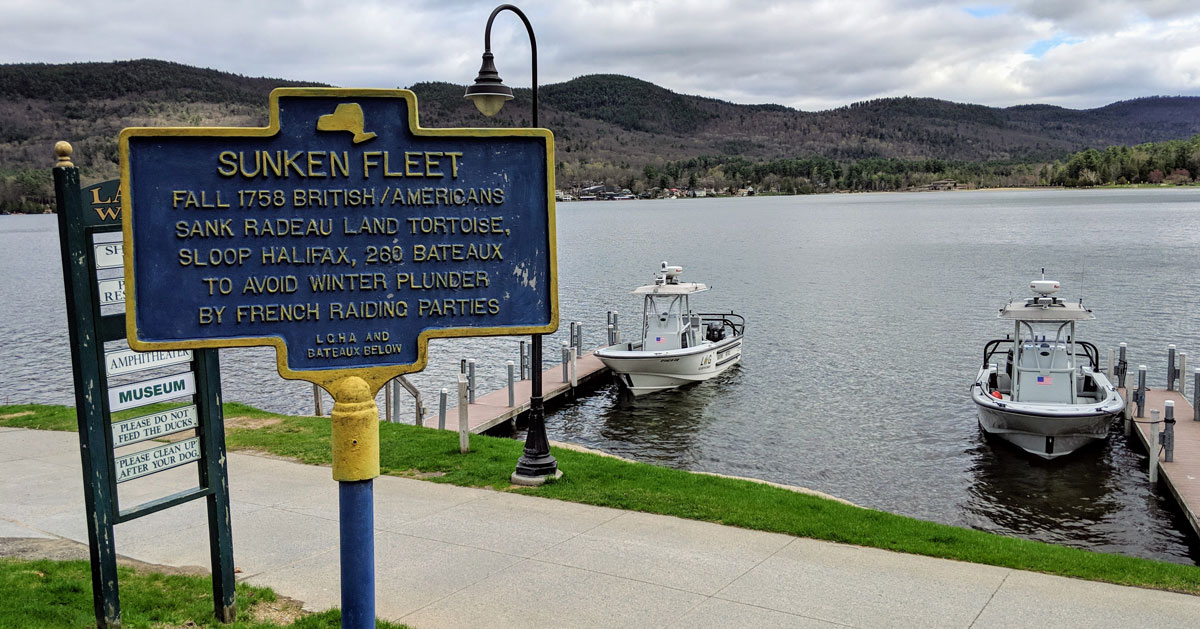
They began the deliberate sinking of much of their fleet in the lake's shallows, placing the warships in a wet or cold storage for the winter. Many of these vessels were retrieved from the lake in 1759 and reused. This was once one of the greatest scuttlings of warships in military history - 260 bateaux were sunk.
These were the utilitarian warcraft of the times. Flat-bottomed, pointed at bow and stern, and some 25 to 35 feet long, many of these bateaux were built in Albany and Schenectady and transported overland to Lake George.
In 1992, seven sunken bateaux were nominated to the National Register of Historic Places by Bateaux Below, Inc. They are listed on the National Register and are also part of a state underwater park for scuba divers called Submerged Heritage Preserves.
A sloop named the Halifax, with a "51 Fleet Keel," was likewise scuttled in 1758. In 1759, it was raised and reused. Row galleys and whaleboats were also part of the sunken fleet. However, the prize of the sunken fleet was the 52-foot long radeau, Land Tortoise.
Not recovered in 1759, it was discovered in 1990, and then surveyed by Bateaux Below, Inc. and the Land Tortoise Radeau Survey. This floating gun battery was pierced for seven cannons and is the only radeau-class warship found for archaeologists to study. In a remarkable state of preservation, due in large part to its 107-foot depth, the radeau is "North America's oldest intact warship."
The Sunken Fleet marker was erected in 1993 by the Lake George Historical Association and Bateaux Below, Inc., two local nonprofit educational corporations.
Continue the Walking Tour to Stop 5: Montcalm's Entrenchments >>
This "Colonial Wars" guide that Mannix Marketing has adapted for lakegeorge.com, with the Alliance's OK, is attributed to Bateaux Below, Inc.
TOUR WRITTEN BY: Dr. Russell P. Bellico, Bob Benway, Tim Cordell, John Farrell, Scott Padeni and Joseph W. Zarzynski
ART BY: Tim Cordell
PHOTOGRAPHY BY: Bob Benway
©1996, 2022 Bateaux Below, Inc. Reprinted 2022 with the permission of Bateaux Below, Inc. Historical updates provided by Dr. Russell P. Bellico and Dr. Lyn Karig Hohmann The reproduction of this brochure has been made possible by an Occupancy Tax Grant award from the Town of Lake George.
Lake George Battlefield Park Alliance PO Box 26, Lake George, NY 12845 www.lakegeorgebattlefield.org
SUGGESTED READING LIST:
Bellico, Russell P. - Chronicles of Lake George - Journeys in War and Peace. Purple Mountain Press, Fleischmanns, NY, 1995.
Bellico, Russell P. - Sails and Steam in the Mountains – A Maritime and Military History of Lake George and Lake Champlain. Purple Mountain Press, Fleischmanns, NY, 2001.
Bellico, Russell P. - Empires in the Mountains - French and Indian War Campaigns and Forts in the Lake Champlain, Lake George, and Hudson River Corridor. Purple Mountain Press, Fleischmanns, NY 2010.
Griffith IV, William R. - The Battle of Lake George - England’s First Triumph in the French and Indian War. History Press, Charleston, South Carolina, 2016
Steele, Ian K. - Betrayals – Fort William Henry & The “Massacre.” Oxford University Press, Oxford, United Kingdom, 1990.
Zarzynski, Joseph W. - Ghost Fleet Awakened - Lake George’s Sunken Bateaux of 1758. State University of New York, Albany, NY, 2019.